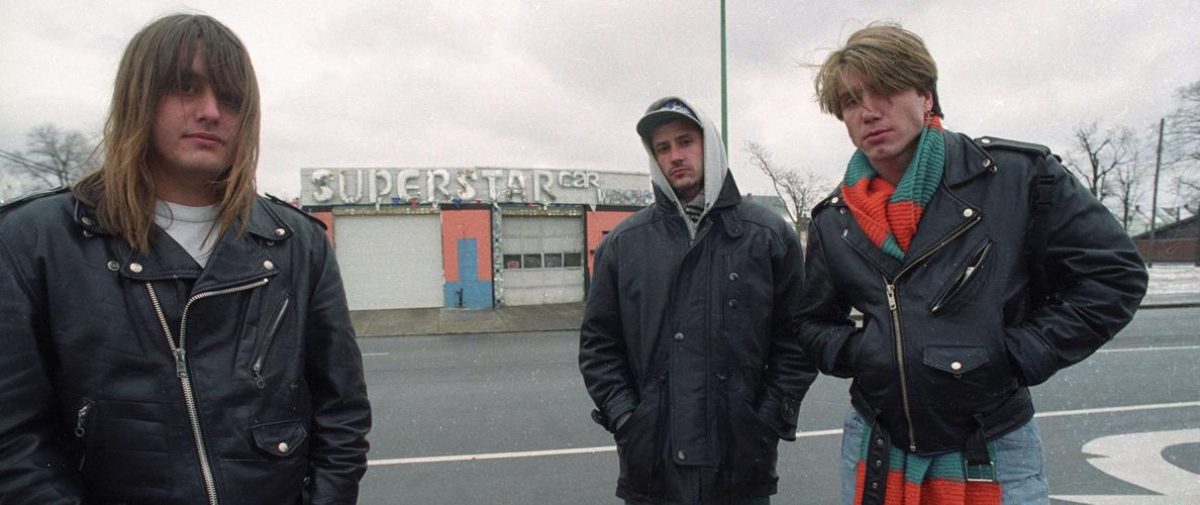
Time to dig into the “A Boy Named Goo” era with more material from those years. Specifically, this is an interview done over the phone by a journalist who was, and probably still is, a very good friend of the band.
This content was forwarded to me by contributor Bailey. There are some interesting bits here, especially in terms of album production and such. What I gathered from the interview, which I find quite interesting, are tidbits of information delineating the following trivia:
- “A Boy Named Goo” was a completed album when former drummer George Tutuska was fired, and they were happy with the results. Personally, I doubt it, as apparently the latter was not liking much the musical direction the band was taking with it, and that may have been a topic which also added to other ones that ultimately led them to clash. Read the dedicated post for more info.
- The band did not feel like working on a real album until they started the recording process for the then-previous release, “Superstar Car Wash”. Until that point, it was more like putting together moments of their lives rather than working on a cohesive project.
- John hinting that he was already prepared to write another album. This makes me think when “A Boy Named Goo” was completed, they most likely already had other finished songs for its sequel. The only song we know for sure was in that stage is “Broadway“, which the band began developing during the production of the album before shelving it for later usage.
Here is the article in all of its glory. Read it and make your own conclusions, if you want. Below are Bailey’s comments about it:
This was done by Janiss Garza, friend of the Goos for many years, and who did multiple different interviews with the Goos over the years (including the one with Artie in ’88).
It says “Unknown source” But it’s probably from the magazine she worked for, RIP, and it’s from 1995, and I know it’s by Janiss (John mentions her name in the interview). This interview is mainly just a casual conversation with John, Robby and Janiss, apparently done over the phone. They mention their dreams of “being a rock star” (though at the time, they didn’t care too much), being interviewed, and what the Dolls would change their name to (if they could), etc. I think my favorite quote is, “You can take the boys out of Buffalo, but you can’t take the Buffalo out of the boys.” This is overall a great interview (funny as well).
Thanks a lot Bailey for the material, as usual.
Buffalo Boys
Unknown Source
00-00-95There are times in rock-n-roll when journalistic objectivity flies out the window. This is one of them. I’ve been friends with the Goo Goo Dolls for six years now – not professional business acquaintances but honest – to -goodness pals. So, as you can imagine, this is meant as a warning, but what you’re about to read isn’t an article per se; rather, it’s a bunch of chum s catching up on things. It’s also an invitation to eavesdrop on our little chat. The Goos are simply open, friendly guys from Buffalo, New York. They don’t mind if you listen in.
The Goos are traveling through Tallahassee, Florida, at the moment and I’m in Los Angeles, so our conversation is via phone. Since guitarist/vocalist Johnny Rzeznik is busy fooling around with an astronomy program on his new Powerbook 150, I talk to bassist/vocalist Robby Takac first. “I lost my pass today. I’m not even gonna be able to get backstage. I’m just kidding….” He means the part about the being able to get backstage. “I did lose it though,” he affirms. Robby’s the carefree – and sometimes careless – band member. You can recognize his songs on the Goo Goo Dolls album fairly simply: They’re usually more frantic and optimistic in the face of high adversity. Only Robby could write a song like “something bad” on their new album, “A Boy Named Goo” – a song whose refrain is “I know that something bad has got to change.”
Johnny’s the more introspective Goo. He’s also the one who lectures me about my love life. So it’s a safe bet that most of the songs moaning about romantic foibles are John’s. Until the beginning of this year, there was also Goo drummer George, but he’s now replaced by Mike Malinin. It wasn’t an easy change. “It was pretty heavy,” Robby confides. “But it was to the point where we probably wouldn’t have been together anymore if we’d kept it like that. I mean, that was an option as well at that point. But we’d finished the record already, and we were really happy with it.”
For this band to break up now would be nothing short of criminal. “A Boy Named Goo”, the Goo Goo Dolls fifth album, is the best of their career and my personal favorite since 1989’s raw, manic “Jed.” Songs like “Long Way Down” and “Burnin’ Up” have an edgy sense of desperation dressed up with to-die-for punk-pop hooks. And instead of presenting their tunes with a cynical chip on their shoulder – typical of so many bands these days – the Goos exude an untempered, hopeful innocence. Although these guys have yet to achieve the success they deserve, it hasn’t dampened their spirits one iota. In fact, Robby believes the band’s just starting to hit its stride. “I just think we know how to make better records now,” he explains. “In the early days we weren’t really making records; we were just going in and kind of documenting what we did. Really, the first record we got to make, I think, was the last one (Superstar Car Wash), as far as actually having it all together. Now we aren’t overwhelmed by the technology – we don’t feel as though we have to use everything in the room, you know?”
Nevertheless, the guys are still capable of dashing into the studio and churning out tunes in classic kamikaze punk style. They did this a few months after the record was done, recording a half-dozen covers in three days. Two of the tunes – “Disconnected” by ‘70’s Buffalo punk rockers the Enemies and the Lime Spiders’ “Slave Girl” – were added to “A Boy Named Goo.” Ironically, the sweet, easygoing Robby does the vocals for “Slave Girl,” a tough song loaded with masculine posturing. I can’t help but kid him about that : “It’s so hilarious picturing you singing that!” “Yeah, that’s what my girlfriend says too,” Robby agrees. “She says that’s why it’s so funny, because it’s just so, like, macho.” “Is this the same girlfriend that you’ve been with forever?” I ask. “Yeah, she’s the best man.” “Did her mom ever decide to like you?” (The last time we spoke at length, he’d told me his girlfriend’s mom cast a disapproving eye over the relationship.) “Nope. She had me over for Christmas last year, but no, she doesn’t like me very much. She thinks I’m a punk. I don’t mean a punk like Manic Panic; I mean a punk like a punk, like what a punk meant in the 50’s. She’s probably right.”
The truth is that the Goos were punk rockers back in the days when heavy metal was king and the guys in Green Day were still finishing high school. Looking back now, a record like Jed sounds almost visionary. At the time, however, the band was just playing what they felt, and it puzzled people. A couple of years later, when Warner Bros. got involved with the Goo Goo Dolls’ career, the guys were touted as the next Replacements – no one thought that punk rock would make a comeback. And people still can’t quite figure the band out. In spite of their catchy tunes, they still stand somewhere outside of the power-pop/punk rock mainstream. Robby claims that its a matter of fashion – or lack of it on the Goos’ part. “I think people are quicker to put that Replacements tag on us than they are the other bands ‘ cause we don’t have the hairdos and the Misfits T-shirts,” he asserts. Momentarily, he gets distracted, “Hey! There’s Goo Pies! We’re watching Gumby, and the character Goo opened up a pie shop. He’s got Blockhead selling pies for him. Sorry. What were you saying?” I repeat that while I’ve noticed the Goo’s songs are getting more sophisticated, their content – the havoc-dished out by everyday events – remains the same. “I don’t think things have been much different through the years,” he affirms. “I mean, they’re fairly confused songs, but I think that’s what we’re doing here.” “Do you think you’re gonna be perpetually confused about life?” I ask. “Oh man, always!” Robby emphasizes. “I can’t figure it out. Although I don’t think anyone really can. So I think that’s why we have people telling us, ‘God, I really relate to what you guys are doing.’ I think, well, it’s probably ‘cause you’re as screwed up as we are! Would you like to speak to Johnny for a little while?” he asks. “I think we’re leaving here in about an hour -“
Johnny hops on the phone line and immediately gives me a hard time for missing their Hollywood show at the Dragonfly a few months earlier. “I couldn’t help it!” I apologize. “I got food poisoning from some Chinese seafood thing I ate.” “See I don’t eat seafood, ‘cause I have a theory about it,” he tells me. “You know where the cow or chicken has been penned and shot up with hormones and fed concrete and newspaper and stuff, but you don’t know where the seafood’s been swimming. Any lunatic from New Jersey could dump a boatload of nuclear waste on top of a bunch of fish and you wouldn’t even know it. Know what I’m saying?” With that he burst out laughing.
Johnny and I always have problems with interview situations. Although he can, and does, give journalists spirited chats, he knows me too well to act official and serious. Besides, he thinks talking about music-biz stuff is absurd. “Everything that surrounds music is far more interesting than the music itself,” he claims. “Like, all the personalities involved in the whole thing are just so much more fun to talk about than the actual music.” Chuckling, he lights into the number-one stupid question that the Goo Goo Dolls – and quite a few other bands -get asked. “Where’d ya get your name?” he mocks. “It’s a stupid name, Janiss. You know what? You guys should have a contest to rename the Goo Goo Dolls. You could win a dream date with the Rock, you know Rock Takac, if you rename the Goo Goo Dolls. I think that’d be hip.” Robby unaware that his band mate has just offered his stud services, is yakking in the background. “Hang on a second,” John says. He then screams into the room, “Shut up!” He returns to the phone. “Sorry. What were you saying?” I’m actually trying to turn the conversation back to band stuff, at least temporarily, so I point out to him that back when the Goo Goo Dolls began, nobody had any idea they’d still be doing it nine years later. “I thought we were just gonna make one record and then laugh about it for the rest of our lives,” John agrees. “But here we are. I can’t wait to write the sixth one. I’m really psyched about it. I’ve got a couple of really neat ideas already for new songs. Plus, there’s a lot of new energy in the band with Mike. We’re into a lot of the same things, and he’s genuinely a good, good guy.” That said we somehow started talking about highballs. I don’t know what one is, so he tells me the recipe. “A highball is cheap whiskey and ginger ale,” he begins. “You gotta make it with Seagram’s Seven whisky. You gotta have a tall glass, lots of ice. A big drink during in the post-World War II years, you know. When people still jitterbugged, that was a big drink. That was one of the things that on the east side of Buffalo – the old men, they all drank their highballs. I’ll make you a highball when we’re in Los Angeles.”
Our rambling conversation is one of the Goo Goo Dolls’ charms: You feel an easy camaraderie just by listening to their music. You can throw any of their albums on the stereo and you pretty much know them. They’re regular guys with all the daily troubles and joys of anyone else. “Sometimes I think you guys are too normal to be rock stars,” I tell Johnny. “Don’t say that!” he yells into the phone. “I wanna be a rock star for a year so I can make some money, buy my wife a car and finish up college. Christ! Even those are normal goals. Arrgh!” Point made. But as Robby said earlier when I shot him the same accusation, “You gotta be interesting for an hour a day. That’s all. The rest of the day’s yours.” And that kind of sensible thinking is why the Goo Goo Dolls continue to survive. You can take the boys out of Buffalo, but you can’t take the Buffalo out of the boys.
 Temple of Goo - The rarest Goo Goo Dolls releases, for real Goo fans only